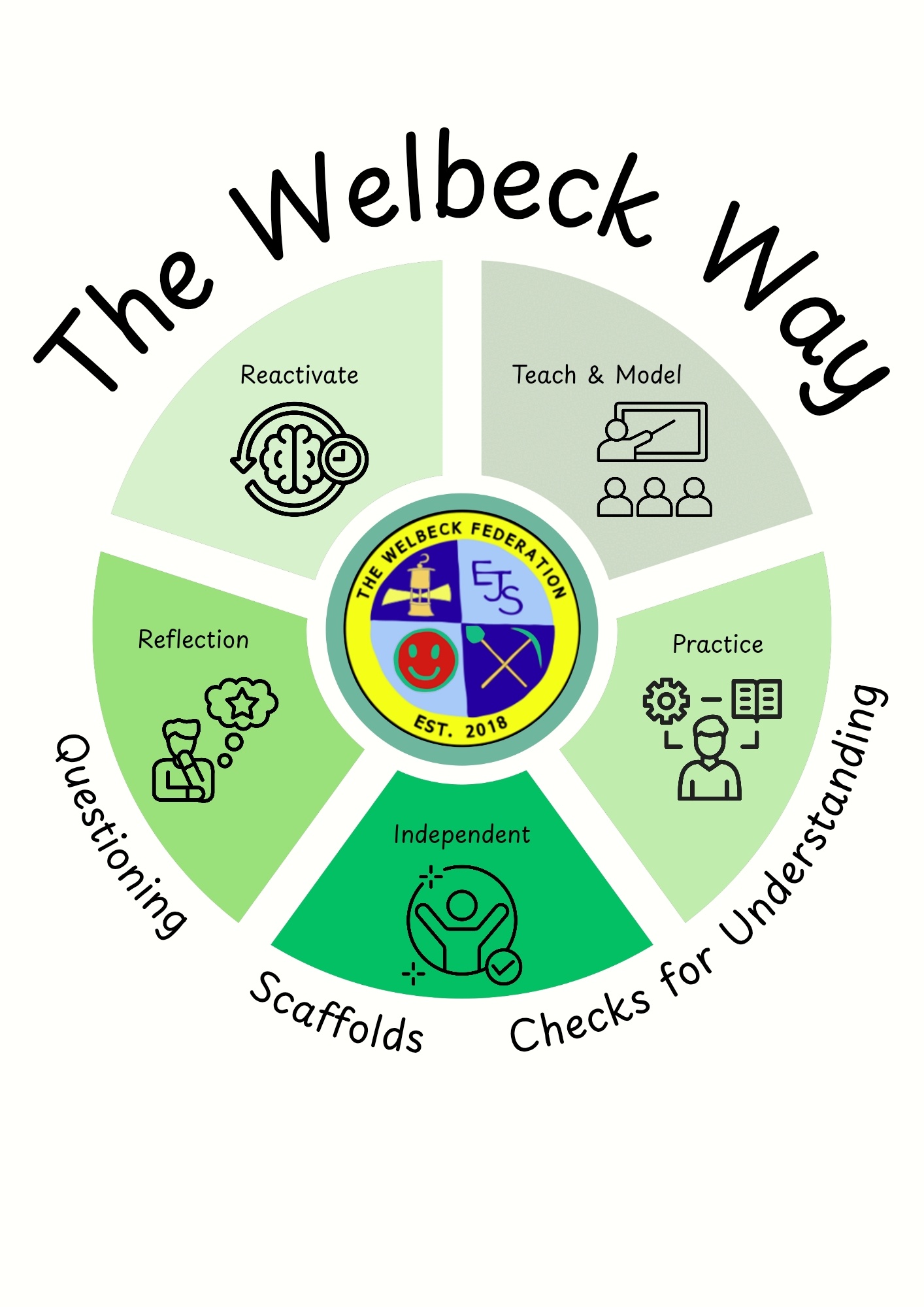
Lesson Design - The Welbeck Way
Our teaching aims to equip all children with the knowledge, skills and understanding needed to make informed choices and confidently apply their learning in new contexts. We strive to ensure every pupil reaches their full academic potential and is well prepared for the future.
Across The Welbeck Federation, we have implemented a research‑informed Teaching and Learning model to secure a consistent, high‑quality approach that enables all pupils to achieve strong outcomes, regardless of starting point or need.
Our lesson design is a flexible, fluid model rather than a rigid framework. Lessons typically begin with a Reactivate phase, followed by Teach and Model. From this point, teachers use their professional judgement to move between sections of the model as appropriate.
Learning objectives should be broken down into clear, manageable teaching points. Each point is explicitly taught and modelled in Teach and Model (TM), then practised by pupils in the Practice (P) phase. Teachers move back and forth between TM and P—known as ping‑ponging—to secure understanding before pupils move into Independent Practice.
Movement between phases should remain responsive and guided by ongoing assessment for learning. If misconceptions arise during Independent Practice, teachers should return to TM to address gaps before pupils resume independent work. This movement should be explicitly communicated to pupils so they understand where they are in the learning journey and why.
The rationale for our lesson design is to:
- Embed a research‑driven mastery approach (Rosenshine, Principles of Instruction, 2012)
- Ensure consistency in teaching across the Federation
- Secure high‑quality teaching so all pupils achieve the best outcomes
- Build coherent learning sequences that support long‑term memory and reduce cognitive load
- Provide sufficient time for pupils to deepen understanding
Enable pupils to make meaningful connections between prior and current learning.